Flags on the Refs: The NFL Suspends Two Officials for Unprofessional Conduct
A line judge and a referee are sitting out games for how they treated players, and the officials' union is fighting back.
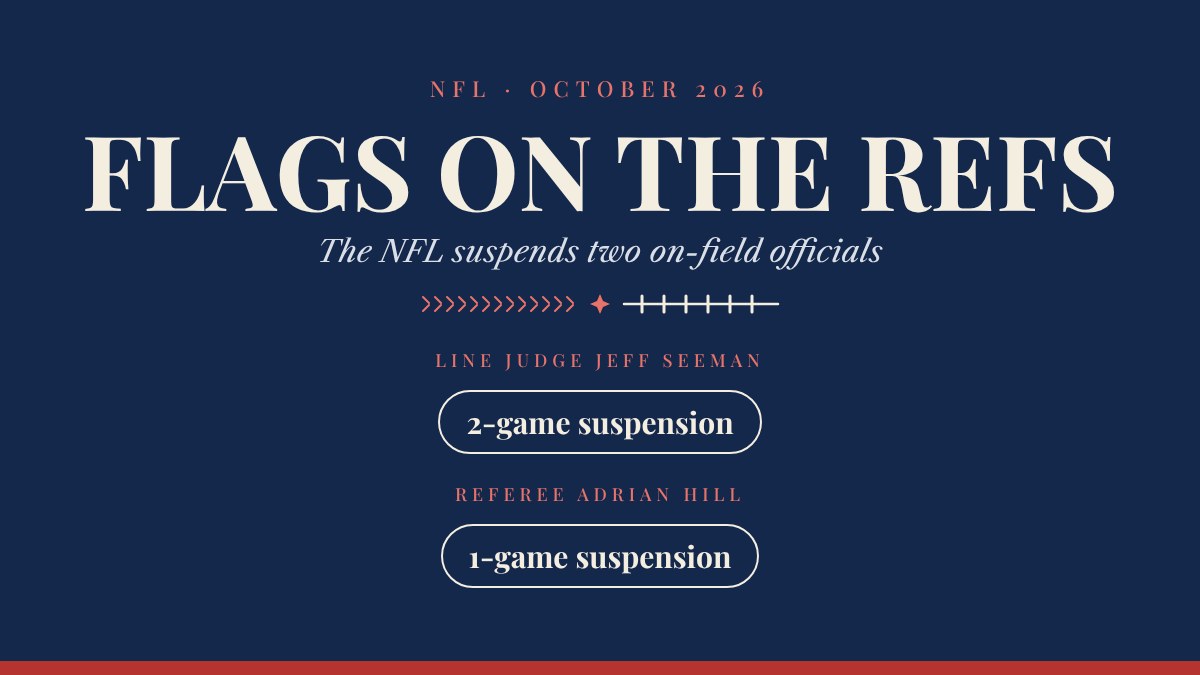
Players get fined and suspended all the time. Officials almost never do. This week, the NFL did something rare: it suspended two on-field officials for unprofessional conduct toward players during Sunday's games.
Line judge Jeff Seeman was suspended for two games, and referee Adrian Hill for one. The NFL Referees Association, the union that represents game officials, quickly pushed back, calling the punishments "excessive" and "inconsistent with past precedent."
By the numbers
2
Officials suspended for conduct toward players
2
Games for line judge Jeff Seeman
1
Game for referee Adrian Hill
2×
Times Seeman cursed at Trey McBride on camera
What happened
Cardinals vs. Giants · Line judge Jeff Seeman
2-game suspension
During a dispute over a missed pass interference call, TV cameras caught Seeman telling Arizona Cardinals tight end Trey McBride "f*** you" twice. The clip spread quickly, and NFL Players Association executive director JC Tretter posted about it, asking that officials be held to the same standard as players.
Dolphins vs. Vikings · Referee Adrian Hill
1-game suspension
Minnesota Vikings linebacker Eric Wilson was blocked into Hill by an opposing player, knocking the referee to the ground. Wilson tried to help him up, but Hill jumped to his feet and aggressively yelled and pointed at him instead.
The union pushes back
The NFL Referees Association didn't defend the behavior. Its statement said officials "have a responsibility to conduct themselves professionally on the field." But it argued that the punishment doesn't fit, and that officials take plenty of abuse themselves: "Holding officials accountable while ignoring or minimizing the conduct directed at them is neither fair nor an effective way to address this issue."
The union plans to challenge the suspensions and meet with both the NFL's officiating department and the players' union about on-field conduct. Under the officials' collective bargaining agreement, the dispute could end up in arbitration.
The economics of it
This is a classic incentives story. Players face clear, public consequences for unsportsmanlike conduct: flags, fines and suspensions. Officials have mostly been graded behind closed doors. When one side's mistakes are punished in public and the other's aren't, behavior drifts. Tretter's point is basically an economist's point: the same rules should create the same incentives for everyone on the field.
It's also a labor economics story. NFL officials are unionized, and their union exists to protect members from discipline it sees as unfair. The fight here isn't really about whether Seeman and Hill crossed a line. It's about the price of crossing it. Setting that price too low invites more blowups; setting it too high, the union argues, ignores the pressure officials work under. Whatever an arbitrator decides becomes the new benchmark for every official in the league.
My unfiltered take
The suspensions are fair. Officials are supposed to be the calmest people on the field, and cursing at a player twice on camera isn't a judgment call. That said, the union has a point about the other side of it: players and coaches yell at officials every week with almost no consequences. If the NFL wants respect to go both ways, it should enforce that too. Accountability works best when it isn't one-sided.
Landrey